
Every automated process needs an owner. Not someone to blame when it fails — someone responsible for ensuring it works.
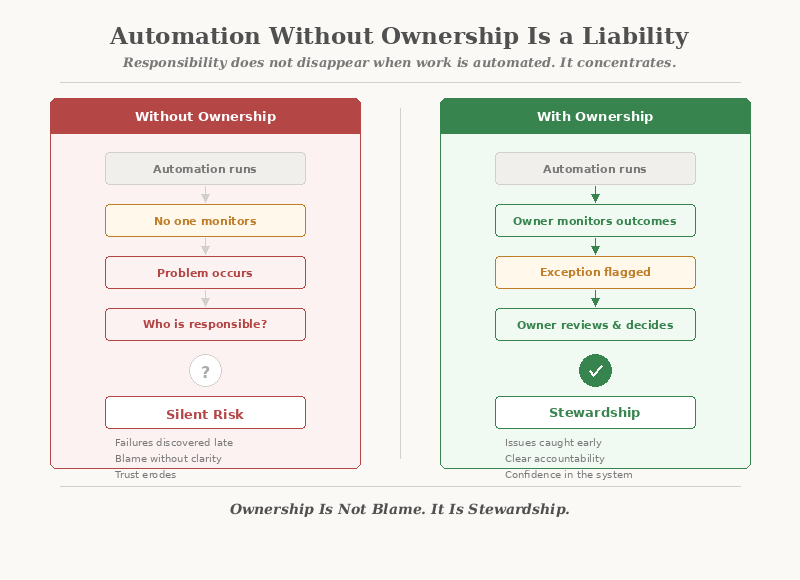
Automation Does Not Eliminate Responsibility
One of the most dangerous assumptions in modern organisations is that automation reduces the need for ownership. In reality, automation increases it.
When a human performs a task:
- They notice exceptions
- They adapt to context
- They take responsibility for outcomes
When a system performs a task:
- It follows rules exactly
- It does not recognise nuance
- It cannot explain its reasoning
Responsibility does not disappear. It simply moves — often without being clearly reassigned.
Where Ownership Usually Breaks Down
In many organisations, automated processes sit in an uncomfortable gap. They are:
- Too technical for operational teams
- Too operational for technical teams
- Too "automatic" for management attention
As a result:
- No one actively monitors outcomes
- Failures are discovered late
- Everyone assumes someone else is responsible
When Things Go Wrong, Confusion Follows
When an automated process fails, the questions come quickly:
Without a clear owner, these questions lead to delays, escalations, finger-pointing, and loss of trust.
The issue is rarely the technology. It is the absence of ownership.
Ownership Is Not Blame
This distinction matters.
Ownership does NOT mean:
- Writing the code
- Fixing every issue personally
- Being punished when something breaks
Ownership DOES mean:
- Understanding the purpose
- Monitoring behaviour
- Reviewing exceptions
- Deciding when changes are needed
- Being accountable for outcomes
Ownership is about stewardship, not fault.
Automation Creates New Decision Points
Every automated process introduces decisions that must be owned:
- When should the automation run?
- When should it stop?
- What happens when data is incomplete?
- How are exceptions handled?
- Who reviews outcomes?
If these questions have no clear answers, the automation becomes a silent risk.
Why This Matters More in Complex Organisations
In public sector, regulated, or multi-department environments, the cost of unowned automation is high.
Without ownership:
- Audit trails are unclear
- Accountability is diluted
- Errors propagate quietly
- Trust erodes — internally and externally
Systems may continue to operate, but confidence in them declines. Once trust is lost, systems are bypassed.
Designing Ownership Into Automation
Healthy automation includes ownership by design. That means:
- Assigning a named role responsible for outcomes
- Making results and exceptions visible
- Defining escalation paths
- Regularly reviewing performance
Ownership should be explicit — not assumed. This applies whether the automation is simple or complex.
The Role of AI Makes Ownership Even More Critical
AI-driven automation increases the need for ownership, not reduces it.
Because AI systems learn from data, produce probabilistic outputs, and change behaviour over time, someone must be responsible for:
- Understanding what the AI is doing
- Interpreting its recommendations
- Deciding when its outputs are acceptable
- Knowing when to intervene
Without ownership, AI becomes ungovernable.
Ownership Is a Leadership Function
Ultimately, ownership of automation is a leadership responsibility.
Leaders don't need to build systems, write code, or manage every detail. They do need to ensure that:
- Automated processes have clear stewards
- Accountability is visible
- Systems serve organisational goals
Automation without leadership attention becomes technical debt.
The Safer Path Forward
Automation works best when it is:
This doesn't slow organisations down. It stabilises them.
Closing Reflection
Automation does not remove responsibility. It concentrates it.
When no one owns an automated process, the organisation carries the risk — quietly, continuously, and often unknowingly.
Clarity begins when ownership is explicit.