
Most operational problems are not caused by missing systems. They are caused by invisible systems.
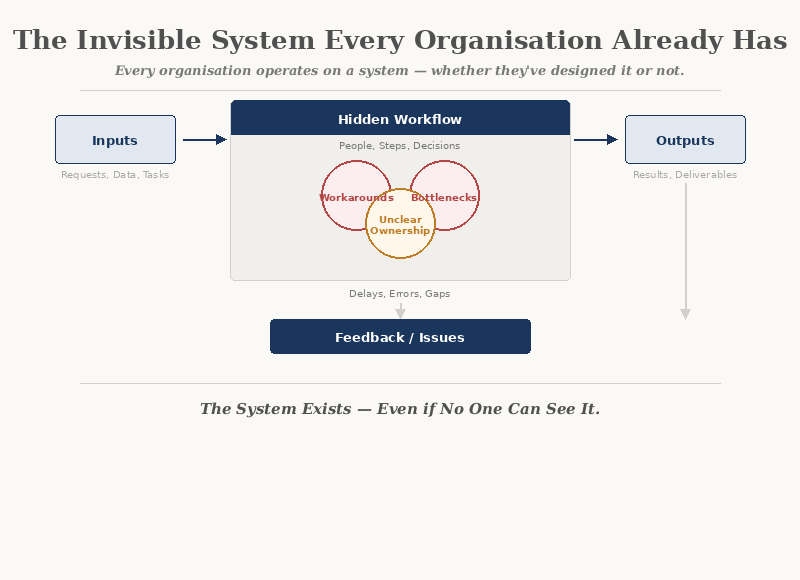
The System You Didn't Mean to Build
Over time, organisations accumulate:
- Processes that evolved informally
- Decisions made to "just get things done"
- Workarounds created under pressure
- Tools added to solve isolated problems
None of these choices are wrong in isolation. But together, they quietly form a system.
This system determines:
- How work actually flows
- Where decisions are really made
- Who carries responsibility (and who doesn't)
- Where things slow down, break, or get stuck
The problem is not that this system exists. The problem is that no one can clearly see it.
Why Most Organisations Feel Chaotic
From the inside, chaos often feels like:
- "We're busy, but not making progress"
- "Things fall through the cracks"
- "We need better software"
- "We need automation"
- "We need AI"
But these are symptoms, not causes.
When the underlying system is invisible:
- Decisions become reactive
- Ownership becomes blurred
- Accountability weakens
- Technology gets blamed for structural issues
The Hidden Flow of Work
Every organisation, regardless of size, follows a basic pattern:
- Something enters the organisation
- It moves through people, steps, and decisions
- An outcome is produced
- Feedback (or consequences) follow
This flow exists whether it is acknowledged or not.
Input
Work enters the system
Process
Steps & decisions
Output
Outcome produced
Feedback
Consequences follow
In many organisations:
- No one owns the entire flow
- Each department only sees their portion
- Problems are discovered late, not early
- Fixes are applied locally, not systemically
Without visibility, leadership manages symptoms instead of structure.
Tools Don't Create Systems — They Expose Them
One of the most common misconceptions is:
"If we add the right tool, the system will improve."
In reality:
- Tools do not create systems
- Tools reveal the system you already have
Automation exposes:
- Where inputs are inconsistent
- Where ownership is unclear
- Where decisions are ambiguous
AI exposes:
- Poor data quality
- Unclear processes
- Conflicting objectives
When these issues surface, the tool is often blamed — even though it simply made the underlying structure visible.
Why "Fixing" Without Seeing Makes Things Worse
When an organisation reacts without seeing the whole system, it often:
- Adds another layer of process
- Introduces more software
- Automates unstable workflows
- Pushes decisions further away from context
Each fix increases complexity. Over time:
- Fewer people understand how things work end-to-end
- Knowledge becomes tribal
- Risk accumulates silently
What's missing is not effort — it's system-level understanding.
Making the Invisible Visible
Clarity begins when an organisation can answer simple questions:
These are not technical questions. They are structural ones.
Once the system is visible:
- Problems become easier to diagnose
- Automation becomes safer
- AI becomes more useful
- Decisions become calmer and more deliberate
Clarity Is Not Control — It's Understanding
Making the system visible is not about bureaucracy or micromanagement. It is about:
Organisations with clarity do not eliminate complexity. They contain it.
The Quiet Advantage
The most effective organisations are not the ones with the most tools.
They are the ones where:
- People understand how their work fits into the whole
- Decisions are made with context
- Technology supports the system instead of fighting it
They have made the invisible visible. And that single shift changes everything.
Closing Reflection
Every organisation already operates on a system.
The question is not whether a system exists — it's whether you can see it clearly enough to improve it.
Clarity always starts there.