
This is not a failure of competence. It is a structural blind spot.
Workflows Exist — Visibility Does Not
Every organisation has workflows. Requests arrive. Tasks are performed. Decisions are made. Outcomes are delivered.
But in many organisations, no single person can clearly see:
- Where work enters the system
- How it moves between people and teams
- Where it slows down
- Where decisions actually occur
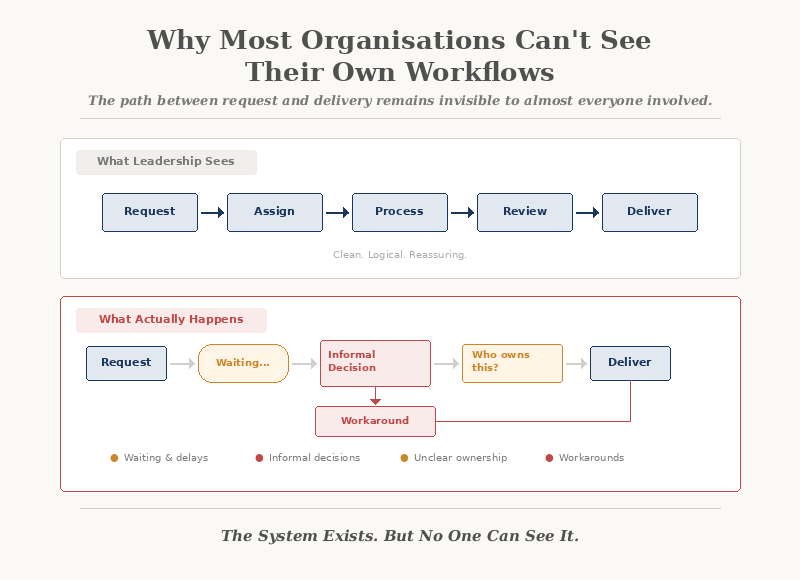
The workflow exists — but it exists in pieces. Each role sees only a fragment. No one sees the whole.
Why Workflows Become Invisible
Workflow invisibility is not accidental. It emerges naturally as organisations grow.
1. Work crosses boundaries
Work rarely stays inside one role or department. It moves across teams, systems, approval layers, and informal handoffs. Each boundary reduces visibility.
No one owns the entire flow — only their part of it.
2. Decisions happen outside formal processes
In theory, work follows documented steps. In reality, decisions often happen in meetings, over email, via messaging apps, or through hallway conversations.
These decisions move work forward — but they leave no visible trace in the system. The workflow continues, but the system doesn't record how.
3. Workarounds replace design
When systems don't support the work, people adapt. They create spreadsheets, use personal task lists, bypass formal processes, and rely on memory and experience.
These workarounds keep the organisation functioning — but they fragment the workflow even further. Over time, the real workflow diverges from the official one.
The Illusion of Visibility
Many organisations believe they can see their workflows because they have project tools, task lists, ticketing systems, and dashboards.
But these tools usually show activity, not flow.
They answer:
- Who is busy?
- What tasks exist?
They don't answer:
- Where work is stuck
- Why delays occur
- Who owns the next decision
- How long work truly takes
Why This Matters More Than It Seems
When workflows are invisible:
- Delays feel unpredictable
- Problems are discovered late
- Accountability becomes unclear
- Improvements are guesswork
Leadership ends up managing by escalation, pressure, and intuition — not by understanding.
This creates a culture where people feel busy but ineffective, teams defend their part of the process, and structural problems are mistaken for performance issues.
Automation and AI Make the Problem Obvious
As organisations introduce automation and AI, this invisibility becomes impossible to ignore.
Automation asks:
"What exactly should happen next?"
AI asks:
"Based on what pattern?"
If the workflow isn't clear:
- Automation fails or becomes brittle
- AI recommendations lack context
- Exceptions multiply
The technology doesn't create the problem. It exposes it.
Seeing Workflows Is a Design Decision
Workflow visibility doesn't happen by accident. It requires a deliberate shift:
- From managing tasks to understanding flow
- From optimising parts to seeing the whole
- From reacting to outcomes to observing movement
This means mapping the real workflow (not the ideal one), including informal steps and decisions, and identifying ownership at each transition.
The goal is not control — it is clarity.
What Changes When Workflows Become Visible
When organisations can see their workflows clearly:
- Delays are easier to diagnose
- Improvements become targeted
- Automation becomes safer
- AI becomes more meaningful
- People regain confidence in the system
Most importantly, discussions shift from blame to structure.
The Quiet Advantage of Seeing the Flow
Organisations that can see their workflows don't necessarily move faster. They move more deliberately.
They understand where effort is wasted, where decisions matter most, and where technology actually helps.
That understanding compounds over time.
Closing Reflection
Workflows don't disappear when they aren't visible. They simply operate beyond awareness.
The organisations that perform best are not the ones doing more work — they are the ones that can clearly see how work moves.
Clarity begins there.