
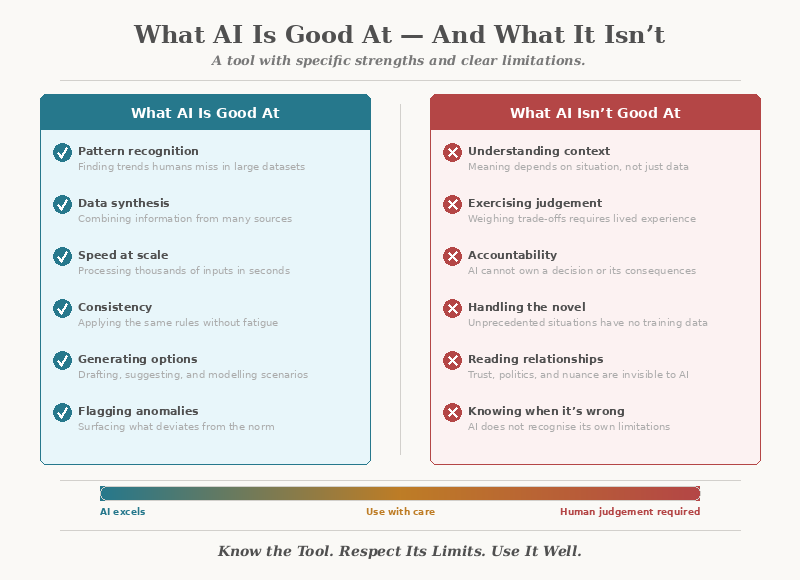
Understanding AI's actual capabilities prevents both underuse and overreach. It is a tool with specific strengths and clear limitations.
The Problem With the AI Conversation
Most conversations about AI fall into two traps:
The hype narrative:
- "AI will transform everything"
- "Just plug it in and watch"
- "It replaces the need for people"
The fear narrative:
- "AI will take all the jobs"
- "You can't trust what it produces"
- "It's too risky to use at all"
Neither is useful. Both prevent organisations from making clear, practical decisions about where AI fits — and where it doesn't.
What's missing is not more opinion. It's a clearer understanding of what AI actually does.
What AI Is Genuinely Good At
AI — particularly the current generation of large language models and machine learning tools — excels in a specific set of tasks. These are real, measurable strengths.
Pattern recognition at scale
AI can process volumes of data that no human team could review in time. It identifies patterns, clusters, trends, and outliers across thousands of records, transactions, or interactions. In a well-structured system, this saves enormous amounts of time.
Drafting and summarisation
AI can generate first drafts of documents, emails, reports, and summaries with speed. It reduces the blank-page problem and allows people to focus on refining rather than starting from scratch.
Classification and sorting
Given clear categories, AI can sort, tag, and route information accurately. Support tickets, enquiries, document types, sentiment — these are tasks where AI provides consistent, scalable results.
Data synthesis
AI can pull together information from multiple sources and present a coherent summary. For leaders who need to understand a situation quickly without reading twenty reports, this is valuable.
Repetitive cognitive tasks
Tasks that require attention but not deep judgement — data entry validation, format checking, consistency reviews — are well suited to AI. They free human attention for work that actually requires it.
What AI Is Not Good At
AI's limitations are not temporary gaps waiting to be fixed. Many of them are structural — built into how the technology works.
Understanding context
AI processes language and data statistically. It does not understand why something matters, what the history is, or what the stakes are for the people involved. Context is what separates a good decision from a technically correct one.
Exercising judgement
Judgement involves weighing competing priorities, ethical considerations, relationships, and consequences. AI can present options. It cannot weigh them the way a person with experience and accountability can.
Handling novel situations
AI works from patterns it has seen before. When a situation is truly new — an unusual customer need, a regulatory shift, a crisis — AI has no pattern to match against. It either fails silently or produces plausible-sounding nonsense.
Knowing what it doesn't know
AI does not have uncertainty in the way humans do. It will produce a confident-sounding answer whether it is accurate or completely fabricated. This is not a bug — it is a fundamental characteristic of how current AI models generate output.
Being accountable
AI cannot take responsibility for outcomes. It cannot explain its reasoning in terms that satisfy auditors, regulators, or affected individuals. Accountability always rests with people.
AI is confident without conviction, fluent without understanding, and productive without accountability.
The Danger of Mismatched Expectations
Most AI failures in organisations are not technical failures. They are expectation failures.
- AI is deployed to make decisions it can only inform
- AI is trusted to handle exceptions it cannot recognise
- AI is expected to improve processes that are not yet understood
- AI is blamed when outcomes go wrong — instead of the system around it
A Practical Way to Think About AI
Rather than asking "What can AI do?" — which leads to an overwhelming list — it is more useful to ask a series of grounded questions about your own work:
These questions point to real, bounded, valuable uses of AI — not aspirational ones.
Where AI Fits in a System
In a well-designed organisational system, AI occupies a clear position:
AI without a system around it is just technology looking for a purpose. AI embedded in a clear system becomes a genuine asset.
Underuse Is as Costly as Overreach
Organisations that avoid AI entirely — out of fear, uncertainty, or scepticism — pay a different kind of cost:
- People spend hours on work AI could do in minutes
- Patterns in data remain hidden
- Response times remain slow
- Competitors who use AI wisely gain an edge
The answer is not to rush into AI or to avoid it. The answer is to understand it clearly enough to use it well.
Start With What You Understand
The best AI implementations are not the most ambitious. They are the most grounded.
They begin with:
- A well-understood workflow
- A specific, bounded task
- Clean, reliable data
- A human who reviews the output
- A clear measure of success
From there, scope can expand — deliberately, with evidence, and with accountability.
The best use of AI is not the most impressive. It's the most honest.
Closing Reflection
AI is not magic. It is not a threat. It is a tool — powerful in specific ways, limited in others.
The organisations that benefit most from AI are not the ones that adopt it fastest. They are the ones that understand it most clearly.
They know what it is good at. They know what it isn't. And they design their systems accordingly.
That clarity is what turns AI from a buzzword into a genuine advantage.