
Organisations obsess over efficiency while ignoring flow. But a fast process that feeds into a bottleneck creates no value. Flow is what turns effort into outcomes.
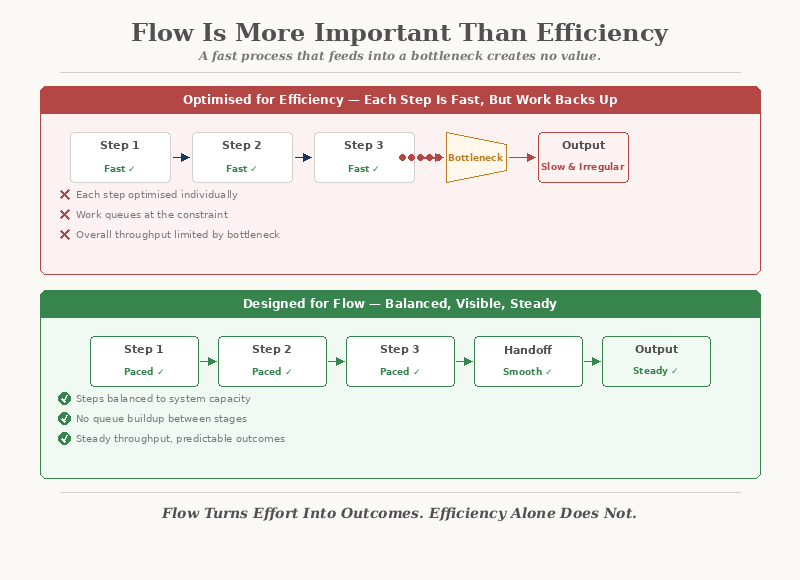
The Efficiency Trap
Efficiency sounds like the right goal. Do more with less. Move faster. Eliminate waste.
But efficiency, measured in isolation, is misleading. A team can be highly efficient at their task and still contribute to a slow, broken system.
Efficient but broken:
- Processing requests in minutes — that wait days for approval
- Producing reports quickly — that no one reads
- Automating handoffs — into queues that overflow
Flowing but effective:
- Work moves steadily from request to delivery
- Handoffs are clean and owned
- Bottlenecks are visible and managed
Efficiency asks: "How fast can this step run?"
Flow asks: "How smoothly does work move through the entire system?"
What Flow Actually Means
Flow is the movement of work through a system — from the moment it enters to the moment it produces an outcome.
Good flow means:
- Work moves without unnecessary waiting
- Each step adds value
- Transitions between people and teams are clear
- Problems are surfaced early, not discovered late
Flow is not about speed. It is about continuity. Work that moves steadily through a system — even slowly — will outperform work that sprints between long pauses.
Where Flow Breaks
In most organisations, flow breaks at predictable points:
Handoffs
Every time work passes from one person or team to another, context is lost, priorities shift, and delays accumulate. The more handoffs, the more fragile the flow.
Queues
Work that waits in a queue is invisible work. It appears done to the sender and not yet started to the receiver. This is where time quietly disappears.
Decision gaps
When a process requires a decision and no one has clear authority to make it, work stalls. It waits for a meeting, an email, a manager — and momentum is lost.
Rework loops
When errors are caught late, work flows backward. Each rework cycle consumes time, erodes trust, and pushes delivery further away.
The Bottleneck Governs Everything
In any system, the overall throughput is limited by its slowest point — the bottleneck.
Improving efficiency anywhere other than the bottleneck does not improve the system. It simply creates more work-in-progress piling up before the constraint.
A team that processes twice as fast but feeds into a bottleneck that hasn't changed has achieved nothing — except more waiting.
This is why organisations can invest heavily in automation, hire more people, and adopt new tools — and still feel stuck. They optimised the wrong part of the system.
Why Organisations Choose Efficiency Over Flow
Efficiency is easier to measure. It lives inside a single team, a single process, a single metric. It looks good in reports.
Flow is harder. It crosses boundaries. It requires system-level thinking. It demands that leaders look beyond their own department.
- Efficiency can be improved locally
- Flow can only be improved systemically
This is why most improvement efforts focus on individual steps rather than the connections between them. It is easier to speed up a task than to redesign how work moves across an organisation.
But the connections are where the real cost lives.
The Hidden Cost of Ignoring Flow
When organisations ignore flow, the symptoms are familiar:
- "We're all busy, but nothing gets done on time"
- "I finished my part — it's waiting on someone else"
- "We keep adding people but things aren't getting faster"
- "Every project takes longer than it should"
These are not people problems. They are flow problems.
The cost compounds over time: missed deadlines, frustrated teams, eroded trust, and a growing sense that the organisation is working hard but going nowhere.
Seeing Flow Requires a Different Lens
To see flow, you need to stop looking at individual steps and start following the work.
These questions shift the conversation from "Who is slow?" to "Where does the system lose momentum?"
That shift changes everything.
Designing for Flow
Organisations that prioritise flow make deliberate choices:
- Reduce handoffs — fewer transitions mean fewer delays
- Make queues visible — if work is waiting, everyone should know
- Place decisions where they're needed — not three levels up
- Limit work-in-progress — starting less means finishing more
- Measure end-to-end time — not just task completion
None of these require new technology. They require structural clarity.
Where Automation and AI Fit
Automation and AI can improve flow — but only when applied to a system that already flows.
Automation helps flow when:
- It removes friction at handoffs
- It accelerates the bottleneck
- It makes queues visible
Automation hurts flow when:
- It speeds up non-bottleneck steps
- It hides waiting behind dashboards
- It removes human judgement at decision points
AI can surface patterns in flow — where delays cluster, where rework concentrates, where decisions stall. But only if the system is visible enough to learn from.
Flow Creates Calm
Organisations with good flow feel different. Not because they work less hard, but because effort translates into progress.
This is not about working slower. It is about working with less friction.
Closing Reflection
Efficiency without flow is motion without progress.
Before you optimise a step, ask whether the work that leaves it has somewhere to go. Before you automate a process, ask whether the system around it can keep pace.
The organisations that deliver consistently are not the ones that work fastest. They are the ones where work flows.
Flow first. Efficiency follows.