
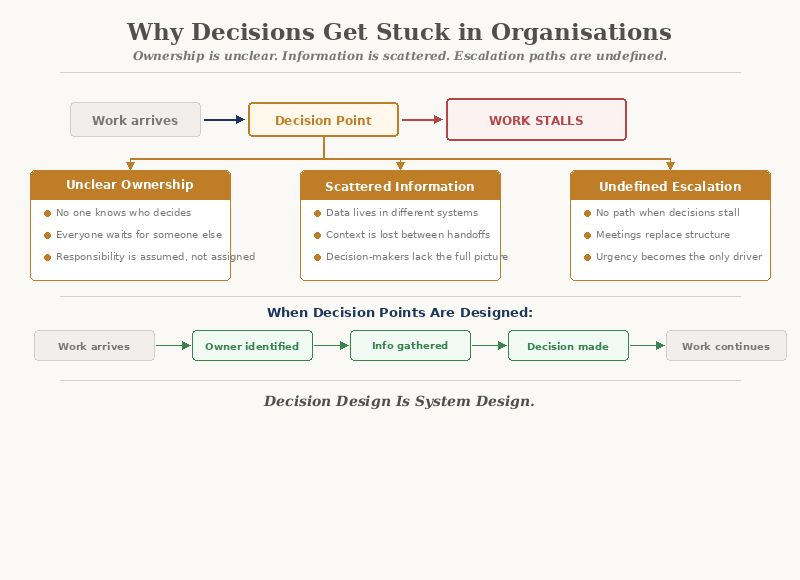
Decisions stall not because people are slow, but because ownership is unclear, information is scattered, and escalation paths are undefined.
Decisions Are Where Work Stops Moving
In most organisations, the work itself is not the bottleneck. People know what to do. They have the skills. They have the tools.
What stops them is the moment a piece of work needs a decision that no one feels authorised — or equipped — to make.
- An exception arises that doesn't fit the standard process
- A request needs approval but it's unclear from whom
- Two priorities conflict and no one has the authority to choose
- Information is missing, and no one knows who holds it
In each case, the work doesn't fail. It simply waits.
The cost of a stuck decision is rarely visible. It shows up as delays, frustration, and missed deadlines — never as the real cause.
The Three Structural Causes
When decisions stall repeatedly, the problem is almost never the individual. It is the system around the decision. Three structural issues account for most stuck decisions in organisations.
1. Unclear ownership
The most common cause. No one is sure whose decision it is. Multiple people could make the call, so no one does. Or the person who should make it doesn't realise it's waiting on them.
Unclear ownership creates a pattern: people hold work, check with colleagues, wait for signals, and eventually escalate — adding time at every step.
2. Scattered information
Even when ownership is clear, the person responsible often cannot decide because they lack what they need. The information exists — but it's in someone else's inbox, a different system, or an undocumented conversation from last week.
Decisions require context. When context is fragmented across tools and people, every decision becomes an investigation.
3. Undefined escalation
When a decision exceeds someone's authority — or their confidence — it needs to move upward. But in many organisations, the escalation path is informal at best, invisible at worst.
Without a clear route, decisions sit in limbo. They are too significant for the current level but have no defined path to the next one.
Stuck decisions are not a people problem. They are a design problem.
What Stuck Decisions Look Like in Practice
From the outside, a stuck decision rarely looks like a stuck decision. It looks like:
- "We're waiting on feedback"
- "It's been escalated"
- "I think Sarah's handling that"
- "It's in the queue"
- "We need to discuss it in the next meeting"
These phrases have become so normalised that they no longer trigger concern. But behind each one is a piece of work that has stopped moving — and often, a person or a client who is waiting.
The Compound Effect
A single stuck decision is minor. But decisions rarely stall in isolation.
When one decision waits, downstream work waits too. Other decisions that depend on it are blocked. People start working on other things, and when the original decision finally comes through, it re-enters a queue of competing priorities.
Over weeks and months, this creates a pattern that compounds:
- Lead times grow longer than the actual work requires
- Urgency replaces planning — everything becomes a rush
- People feel busy but unable to complete anything
- Trust in the system declines
The organisation is not slow because of the work. It is slow because of the spaces between the work.
Why Adding More Meetings Doesn't Help
The most common response to stuck decisions is to create more meetings. Weekly reviews. Alignment sessions. Decision forums.
These sometimes help — but more often, they create a new kind of bottleneck.
The intention:
- Create space for decisions
- Get the right people together
- Resolve blockers in real time
The reality:
- Decisions wait for the meeting
- Agendas overflow with accumulated items
- Smaller decisions never get airtime
Meetings can support decision-making. But they cannot substitute for a system where decisions have clear owners, clear information, and clear paths.
What Unsticking Decisions Actually Requires
Improving decision flow is not about speed. It is about structure.
When these questions have answers, decisions move. When they don't, decisions wait.
Decision Design Is System Design
Decisions are not separate from workflows. They are embedded in them. Every workflow contains decision points — moments where work pauses until a choice is made.
Designing better decision flow means:
This is not bureaucracy. It is operational clarity — and it is one of the most effective ways to improve how an organisation performs.
Where Technology Fits
Technology can support decision flow — but only after the structure is in place.
- Workflow tools can route work to the right decision-maker automatically
- Dashboards can surface the information decisions require
- Alerts can flag decisions that have been waiting too long
- AI can assist with lower-stakes classification and triage
But none of this works if the underlying decision structure is unclear. Technology accelerates whatever is already there — including confusion.
Closing Reflection
Decisions are the heartbeat of every organisation. When they flow, work flows. When they stall, everything downstream stalls with them.
The fix is rarely about asking people to decide faster. It is about designing a system where the right person, with the right information, knows it is their call to make.
Unsticking decisions begins with making them visible — and giving them a home.