
Between request and delivery lies a reality few organisations ever document: the waiting, the workarounds, the informal decisions, and the human judgement that keeps things moving despite the system.
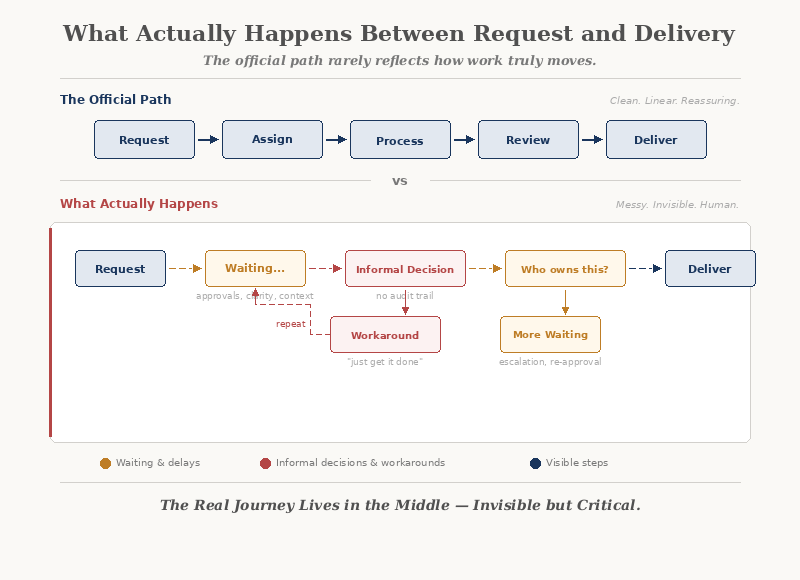
The Official Path vs the Real Path
The official process describes how work should move. The real process describes how work does move.
The difference between the two is not incompetence. It is adaptation.
People adapt when:
- Information is incomplete
- Systems are slow
- Responsibilities are unclear
- Exceptions become the norm
These adaptations accumulate quietly, layer by layer, until the real workflow diverges significantly from the documented one.
Where the Real Work Lives
If you want to understand what actually happens between request and delivery, you won't find it in policy documents or workflow tools.
You'll find it in:
- Email threads
- Messaging apps
- Personal task lists
- Verbal agreements
- "Can you just handle this?" conversations
This is where work is prioritised, redirected, delayed, or accelerated. It is also where visibility disappears.
Waiting Is the Largest Hidden Step
Most process maps focus on action. What they ignore is waiting.
Work waits for:
- Approvals
- Clarification
- Availability
- Decisions
- Context
Waiting time often exceeds processing time — yet it is rarely measured, owned, or discussed.
From the outside, nothing appears wrong. From the inside, momentum quietly drains away.
Decisions Without a Home
In many organisations, decisions are not embedded in workflows. They happen in meetings, between meetings, outside systems, and without documentation.
These decisions move work forward, but they leave no trace.
Later, when questions arise, no one can easily answer:
The decision existed — but the system never captured it.
Workarounds Are a Signal, Not a Failure
Workarounds are often seen as problems to eliminate. In reality, they are signals.
They indicate:
- Where the system doesn't support the work
- Where flow breaks down
- Where people compensate for missing structure
Ignoring workarounds means ignoring how work truly happens.
Why Mapping "What Should Happen" Falls Short
Ideal process maps are useful — but incomplete. They assume:
- Stable inputs
- Predictable conditions
- Clear decisions
- Uniform behaviour
Real work is messier.
When organisations design systems based only on ideal paths:
- Exceptions overwhelm the process
- Automation becomes brittle
- People lose trust in the system
A system that ignores reality will always be bypassed.
Seeing the Real Flow Changes the Conversation
When organisations map what actually happens:
- Frustration becomes insight
- Delays become explainable
- Ownership becomes clearer
- Improvement becomes possible
The conversation shifts from:
"Why didn't this happen?"
to:
"What in the system made this outcome likely?"
That shift is where maturity begins.
The Role of Automation and AI — Later, Not First
Automation and AI work best when the real workflow is understood.
Once the true path between request and delivery is visible:
- Stable steps can be automated safely
- Decision points can be supported with insight
- Exceptions can be handled deliberately
When applied too early, technology magnifies confusion. When applied at the right time, it strengthens flow.
Clarity Lives in the Middle
Most organisations focus on the request (inputs) and the delivery (outputs).
The real leverage sits in the middle.
That is where:
Seeing what happens there is not optional. It is foundational.
Closing Reflection
The distance between request and delivery is rarely empty.
It is filled with human decisions, delays, and adaptations that keep work moving — often invisibly.
Organisations that learn to see this middle ground gain more than efficiency. They gain understanding.
And understanding is the starting point of any meaningful system design.