
Frameworks describe how things should work. Reference implementations show how they actually work.
Why Theory Alone Is Not Enough
Most organisations have access to good ideas. They read about best practices. They attend conferences. They understand, at least conceptually, that systems thinking, clear workflows, and sensible automation are valuable.
And yet — most struggle to apply these ideas.
The gap is not knowledge. It is translation.
- How does "make the system visible" look in practice?
- What does "automation with accountability" actually involve?
- Where does AI add value without adding risk?
These questions cannot be answered in the abstract. They require a working example — something concrete that can be examined, tested, and adapted.
A reference implementation is that working example. It turns principles into something you can see, touch, and evaluate.
What a Reference Implementation Is
A reference implementation is a functioning system — built to demonstrate how a set of principles work together in practice.
It is not a prototype. It is not a proof of concept. It is not a demo built to impress.
It is a real, operational system that embodies the design philosophy it represents.
A reference implementation IS:
- A working system with real structure
- Built on defined principles
- Designed to be examined and learned from
- A foundation for adaptation
A reference implementation is NOT:
- A sales demo
- A template to copy blindly
- A finished product for every context
- A replacement for thinking
Its purpose is to make the invisible visible — to show how decisions, structures, and technologies connect in a coherent whole.
What It Demonstrates
A well-built reference implementation demonstrates several things simultaneously:
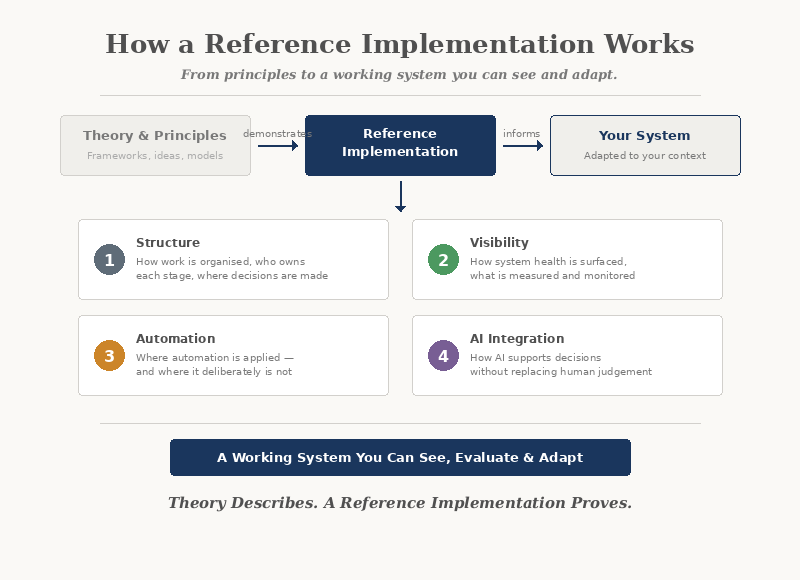
Structure
How work is organised. How inputs flow through the system. Where decisions are made. Who owns each stage. Structure is the foundation — and a reference implementation makes it explicit rather than assumed.
Visibility
How the system's health is surfaced. What is measured. What is monitored. How exceptions are tracked. Visibility turns a hidden system into one that can be understood, discussed, and improved.
Automation
Where automation is applied — and, critically, where it is not. Which steps are automated, which remain manual, and why. A reference implementation shows that automation is a deliberate design choice, not a default.
AI Integration
How AI supports decisions without replacing them. Where it adds value. How its outputs are governed. A reference implementation demonstrates that AI works best when it operates within a system that is already understood.
Together, these layers show how a complete system functions — not as isolated features, but as an integrated whole.
Why "Show, Don't Tell" Matters
Organisations are understandably sceptical of consultants who speak in frameworks but cannot show results.
A reference implementation addresses this directly:
- It provides evidence that the approach works
- It allows stakeholders to see the system in action
- It creates a shared point of reference for conversation
- It reduces the abstraction gap between strategy and execution
That shift — from doubt to adaptation — is where real progress begins.
The Difference Between a Demo and a Reference
Demos are designed to impress. Reference implementations are designed to instruct.
A demo:
- Shows the best-case scenario
- Hides complexity
- Focuses on features
- Optimises for first impressions
A reference implementation:
- Shows the real-case scenario
- Exposes design decisions
- Focuses on principles
- Optimises for understanding
A demo says: "Look what this can do." A reference implementation says: "This is how it works — and here is why."
How to Use a Reference Implementation
A reference implementation is not something to copy. It is something to learn from.
The most effective approach involves three steps:
The goal is not replication. It is informed design — using a working example as a foundation for your own system.
What Makes a Good Reference Implementation
Not every working system qualifies as a useful reference. A good reference implementation has specific qualities:
A reference that hides its trade-offs is just marketing. A reference that exposes them is a teaching tool.
Why Organisations Struggle Without One
Without a reference implementation, organisations face a familiar cycle:
- They understand the principles but cannot translate them
- They invest in tools before designing the system
- They automate before stabilising
- They introduce AI before understanding their own workflows
Each of these mistakes stems from the same root: the absence of a working example to learn from.
A reference implementation breaks this cycle. It provides the concrete starting point that theory alone cannot offer.
The Role of the Consultant
In systems thinking consulting, a reference implementation serves a dual purpose.
For the client, it provides:
- Confidence that the approach is proven
- A tangible basis for discussion and planning
- A faster path from concept to execution
For the consultant, it provides:
- A foundation that has been tested and refined
- A shared language with the client
- A starting point that reduces ambiguity and accelerates understanding
The reference does not replace the work of understanding each client's unique context. It accelerates the conversation so that the real work — adaptation, design, and implementation — can begin sooner.
From Reference to Reality
The ultimate value of a reference implementation is not the system itself. It is what it enables:
- Faster alignment between stakeholders
- Clearer requirements for system design
- More deliberate technology choices
- A stronger foundation for long-term evolution
Organisations that begin with a reference build better systems — not because they copy, but because they start with understanding rather than assumption.
Closing Reflection
Theory describes what should work. A reference implementation proves what does work.
The distance between a good idea and a working system is not bridged by more reading, more planning, or more tools. It is bridged by a concrete example that makes the abstract tangible.
Understanding starts with seeing. And a reference implementation is the clearest thing to see.