
When no one owns a process, everyone owns it. Which means no one does. And the cost of that ambiguity is far greater than most organisations realise.
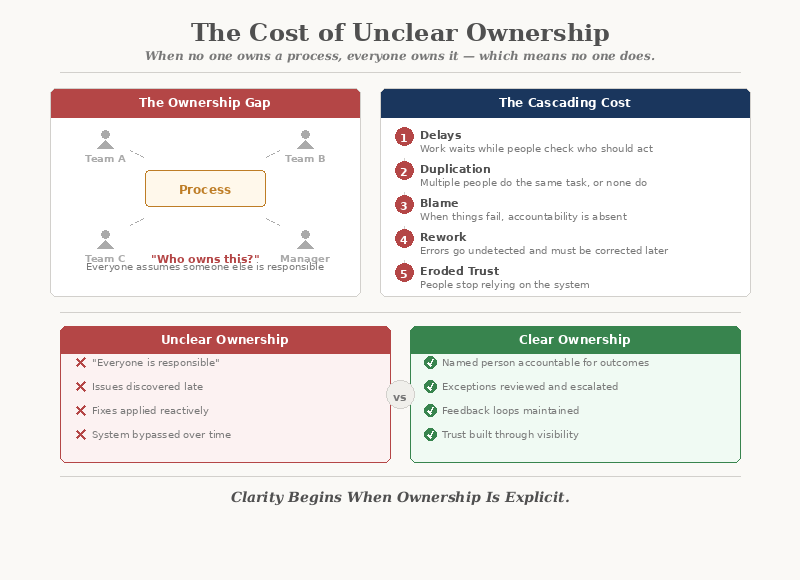
The Ownership Gap
Most organisations do not have a shortage of capable people. They have a shortage of clear ownership.
Ownership gaps appear when:
- A process spans multiple teams but belongs to none
- A task is "everyone's responsibility" — which means it is no one's priority
- A role description says "support" or "contribute" but never "own"
- An outcome is expected, but no individual is accountable for delivering it
These gaps rarely exist because of negligence. They form naturally — through growth, reorganisation, and the quiet accumulation of shared but unassigned work.
Unclear ownership is not a gap anyone creates on purpose. It is one that forms in the spaces between roles.
What Unclear Ownership Actually Costs
The cost of ambiguous ownership is rarely tracked. There is no line item for it. But it shows up everywhere.
Duplicated effort
Two people do the same work because neither knows the other is doing it. Or worse — both assume the other is handling it, and no one does.
Delayed decisions
When no one owns a process, no one owns the decisions within it. Work stalls while people wait for someone to step forward — or for someone senior enough to notice.
Eroded accountability
When things go wrong in an unowned process, the post-mortem becomes a circle of deflection. No one is responsible, so nothing changes.
Quiet resentment
In the absence of clear ownership, the most conscientious person picks up the work. Over time, this creates an uneven burden — and the people carrying it grow frustrated, not because they are unwilling, but because the system is unfair.
How Ownership Becomes Unclear
Ownership does not usually start unclear. It drifts there over time.
Common causes:
- Roles change but processes don't update
- Teams restructure without reassigning accountability
- New tools are introduced but no one is made responsible for them
- Processes evolve informally without documentation
Warning signs:
- "I thought you were handling that"
- "That's not really my area"
- "It's a shared responsibility"
- "We should probably figure out who owns this"
If these phrases sound familiar, ownership has already drifted. The question is how far.
Shared Responsibility Is Not the Same as No Responsibility
There is an important distinction that many organisations blur.
Shared responsibility means multiple people contribute to an outcome — with clear roles, defined handoffs, and someone accountable for the result.
Unclear ownership means the same outcome is expected, but no one has been explicitly named as the person who ensures it happens.
The difference is structural, not semantic. Shared work can function beautifully — but only when someone owns the whole.
Collaboration needs a centre of gravity. Without it, shared work becomes scattered work.
What Clear Ownership Looks Like
Ownership does not mean doing everything alone. It means being the person who:
Clear ownership does not require hierarchy. It requires explicitness. A named person, a defined scope, and the mandate to make decisions within it.
The Leadership Responsibility
Ownership clarity is a leadership function. Teams cannot assign it to themselves — not because they lack the will, but because ownership gaps typically span the boundaries between teams.
Leaders create ownership clarity by:
- Naming an owner for every critical process — not just every project
- Reviewing ownership regularly, especially after restructures
- Distinguishing between "involved in" and "responsible for"
- Making ownership visible — in documentation, in tools, in conversation
This is not micromanagement. It is the foundation of a system that works without constant intervention.
Ownership Before Automation
Ownership clarity matters even more when automation and AI enter the picture.
An automated process without an owner is a silent risk. It runs, produces outputs, and affects decisions — but no one is watching whether it is doing so correctly.
Before automating any process, the first question should always be: who owns this?
If the answer is unclear, the process is not ready for automation. It is ready for a conversation about ownership.
Closing Reflection
Unclear ownership is one of the quietest and most expensive problems in any organisation. It does not announce itself. It accumulates — in delays, in duplicated work, in frustration, and in outcomes that no one feels responsible for.
The fix is not complex. It is honest.
Name the owner. Define the scope. Make it visible. Everything else follows from there.